

 Sample
 Yocan® U.S.A. Official Store
 Yocan® Canada Official Store
 Yocan Black® Official Store
Industry News, News
Yocan Black Pocket Mini: Efficiency Without the Mode Switch
If the Yocan Black Pocket Travel Kit’s dual-mode system sounds useful, the obvious question is: why doesn’t every Pocket model have it?
The answer comes down to what the Yocan Pocket Mini was designed to be. The Mini’s entire value proposition is size. It’s built to disappear into a pocket, to be the device you grab without thinking about it. That kind of portability doesn’t come free—it requires trimming anything that adds physical or engineering complexity. A mode-switching system, however simple for the user, still means extra firmware logic, additional power management, and a button behavior that has to be taught.
So the Pocket Mini skips it. What you get instead is the purest version of the Pocket experience: one mode, one button, and a footprint small enough to forget you’re carrying it. That’s not a flaw. It’s a trade-off, and a deliberate one. Some users don’t want to think about STD versus ECO. They want to press the button and go. For them, the Mini’s simplicity is the feature.
But it does leave a gap. If you want the full-power performance of the Pocket line and the efficiency options that make longer trips possible, the Mini alone won’t get you there. That’s exactly the gap the upgraded version was built to close—and that’s what we’ll look at next.
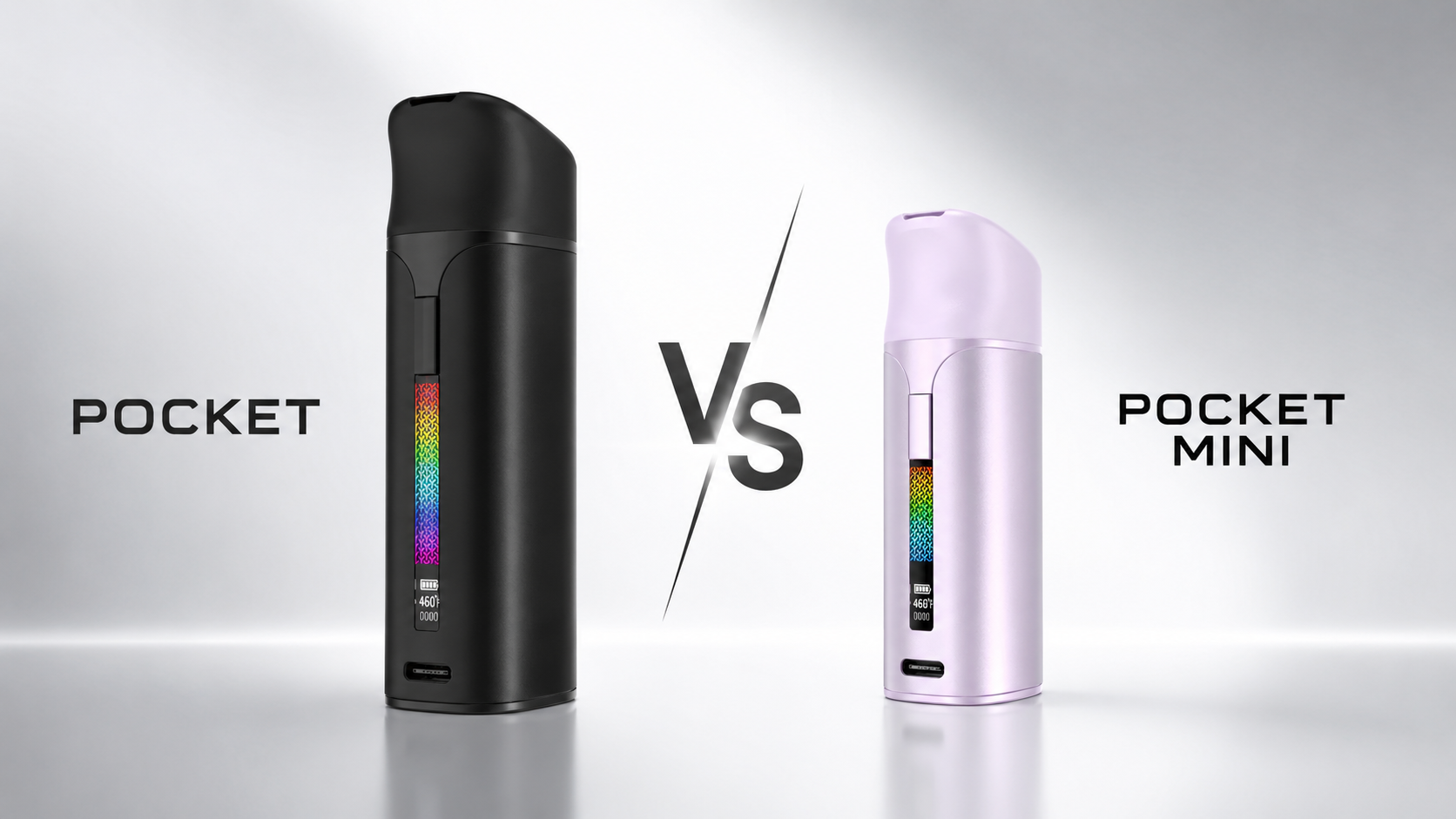
Why the Pocket Mini Doesn’t Have STD and ECO Modes
If the Yocan Black Pocket Travel Kit’s dual-mode system sounds useful, the obvious question is: why doesn’t every Pocket model have it? The answer comes down to what the Pocket Mini was designed to be. The Mini’s entire value proposition is size. At just 26 × 32 × 86mm, it’s built to disappear into a pocket. That kind of portability doesn’t come free—it requires trimming anything that adds physical or engineering complexity. A mode-switching system, however simple for the user, still means extra firmware logic, additional power management, and a button behavior that has to be taught.
So the Pocket Mini skips it. What you get instead is the purest version of the Pocket experience: one mode, one button, and a footprint small enough to forget you’re carrying it.
That’s not a flaw. It’s a trade-off, and a deliberate one. And the Mini makes that trade-off clear in its specs:
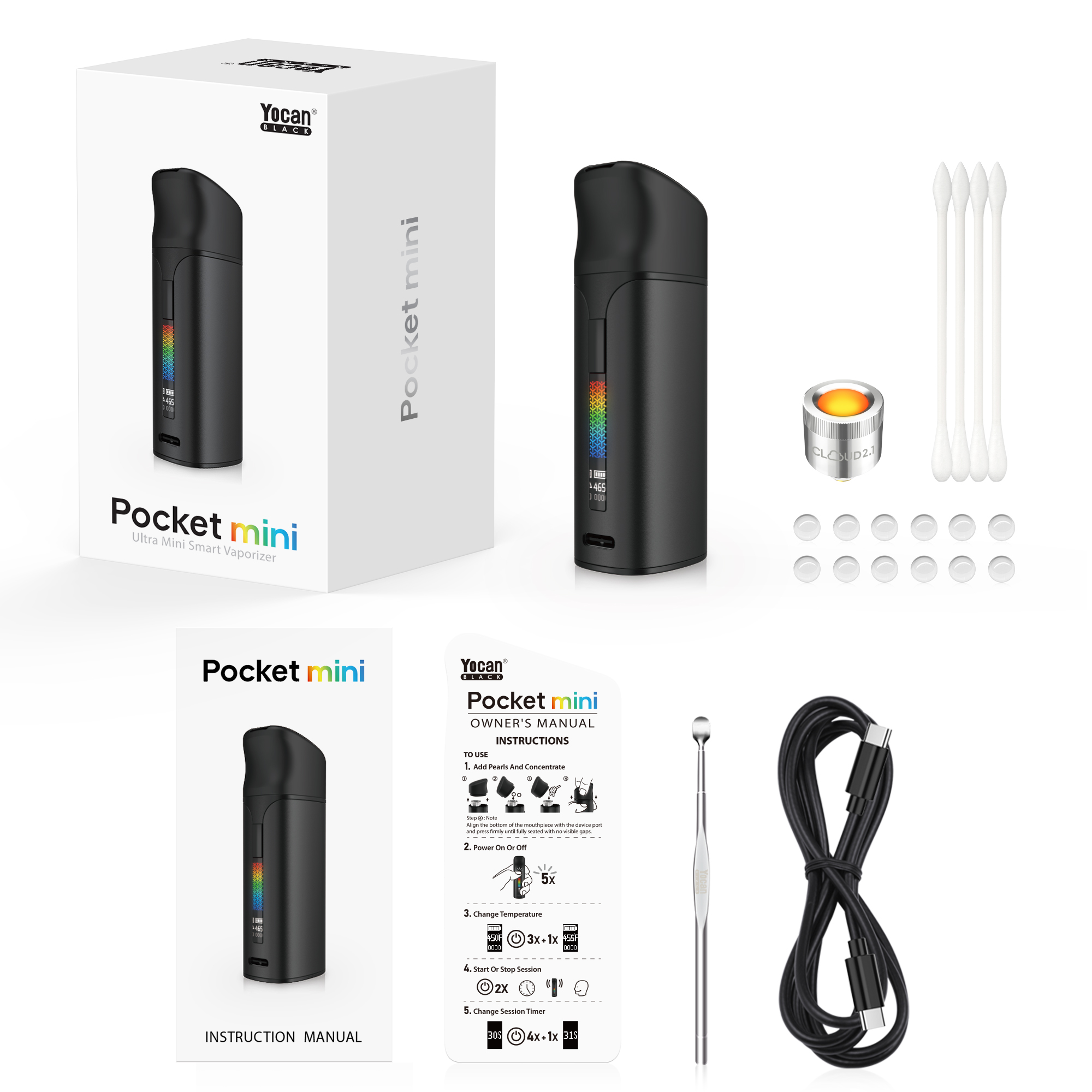
- 1300mAh battery — smaller than the Travel Kit’s 1400mAh, but sized to match the Mini’s compact body
- Cloud 2.1 Chamber — a simpler, pre-installed chamber compared to the Travel Kit’s Cloud 3.1
- 10-second preheat and 15–60 second session timer — a fixed, straightforward session flow
- 400–580°F temperature range — the same top-end range as the Travel Kit, controlled by 3 clicks to enter temperature mode, then 1 click per 5°F step
- OLED display, RGB LED, and vibration reminder — the same feedback system, just without a mode indicator
Everything the Mini does, it does without asking you to choose. You press the button five times to power on, twice to start a session, and the device handles the rest. No STD, no ECO, no decision. For some users, that’s exactly the point. They don’t want to think about power profiles. They want to press the button and go. For them, the Mini’s simplicity is the feature.
But it does leave a gap. If you want the full-power performance of the Pocket line and the efficiency options that make longer trips possible, the Mini alone won’t get you there. That’s exactly the gap the upgraded version was built to close—and that’s what we’ll look at next.
The Pocket Mini’s Real Upgrade: Efficiency, Not Modes
Here’s the thing: the Pocket Mini doesn’t need STD and ECO modes, because it already does more with less. Put the specs side by side. The Yocan Black Pocket Travel Kit runs on a 1400mAh battery with the Cloud 3.1 Chamber. The Pocket Mini runs on a 1300mAh battery with the Cloud 2.1 Chamber. Smaller battery. Smaller device. And yet—Both are rated for up to 15 sessions per charge.
That’s the upgrade. The Pocket Mini doesn’t get its runtime from a bigger battery. It gets it from efficiency. The Cloud 2.1 Chamber’s deeper design and 360° ceramic heating squeeze more usable sessions out of every charge, which is why a 1300mAh device matches the session count of a 1400mAh one.
So when the question is “why doesn’t the Pocket Mini have STD and ECO modes,” the honest answer is: it already operates at peak efficiency. The mode system on the Travel Kit exists because that device can afford to trade runtime for power. The Mini was engineered to avoid that trade-off in the first place.
It’s a quieter kind of upgrade—not a feature you toggle, but a spec you feel. You charge less often because the device does more with what it has. And for a pocket-sized concentrate vaporizer, that’s the upgrade that actually matters.
Final Thoughts
The Yocan Black Pocket line gives concentrate users two clear paths. The Yocan Black Pocket Travel Kit is the one with STD and ECO modes—full power when you want it, efficiency when you need it, and a 5-second button hold to switch between them. It’s the choice for anyone who wants control over how their device performs.
The Yocan Pocket Mini takes a different route. At 26 × 32 × 86mm with a 1300mAh battery, it matches the Travel Kit’s session count without the mode system, because the Cloud 2.1 Chamber was built to be efficient from the start. It’s the choice for anyone who’d rather carry less and charge less often.
Neither one is the “better” version. They’re two answers to the same question: how do you want to vape on the go? If you want to switch modes, go with the Travel Kit. If you want a device that’s already optimized, go with the Mini.
Either way, you’re getting the same thing that matters—more sessions, fewer compromises.